
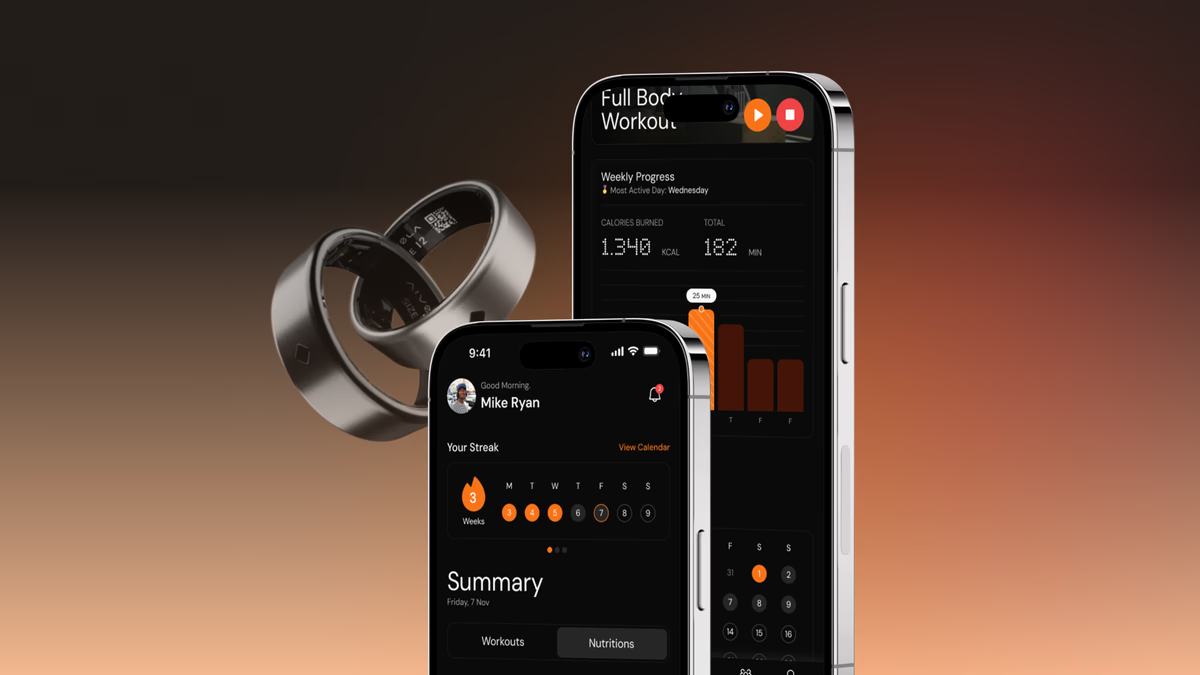
We have developed an AI health ring app tailored to daily health management scenarios in the Southern European market. The system continuously collects multi-dimensional data such as sleep, recovery status, and activity load through wearable hardware, and then analyzes it in combination with personal historical trends to generate status reminders, anomaly alerts, and personalized improvement suggestions. This allows users to not just glance at numbers occasionally, but to continuously understand what changes are happening in their bodies.
What users truly need is not more data, but what to do next
Health devices are proliferating, and users are seeing more and more data, but "data richness" and "truly understanding the body" are not the same thing. A single sleep duration, activity level, or recovery metric makes it hard to explain why you feel tired today, or to determine whether recent changes in your status are worth paying attention to.
We believe that the real value of a ring lies not just in its lightness and all-day wearability, but in its ability to establish a continuous personal health baseline. Therefore, we shifted our project focus from "displaying metrics" to "explaining changes," so that continuous sensing ultimately translates into actionable recommendations that users can understand and execute.
Reminders can't be absent, but they shouldn't cause unnecessary anxiety
Physiological data naturally fluctuates with sleep patterns, mood, and environment. If the system relies solely on uniform thresholds, it is prone to frequent false alarms; however, overly conservative judgments may miss changes that truly warrant attention. The core challenge of this project lies in establishing personalized assessments rather than simply applying industry averages.
Health-related products must also clearly distinguish between "health management recommendations" and "medical diagnosis." When addressing Southern European and multilingual markets, user authorization, sensitive data permissions, result interpretation, and disclaimers directly impact the product's long-term viability.
Establish a personal baseline first, then provide measured health advice
We place sleep, recovery, activity, and circadian rhythm metrics on a single timeline, combine them with the user's historical data to identify changes, and then translate complex results into trends, risk alerts, and actionable recommendations. Users no longer see a pile of isolated numbers but a more understandable narrative of their body's changes.
In terms of data and compliance design, we adopt tiered authorization and data minimization principles, clearly define the assistive nature of AI results, and set independent permissions for accounts, devices, and family members, so users always know which data is used and who can see it.
For long-term operations, we let the ring hardware serve as the acquisition and data entry point, while deep reports, long-term trend analysis, and personalized plans continuously deliver value through membership subscriptions.
Ultimately, what we solve is not "whether the device can measure more data," but "whether users truly know how to improve once they have the data."
Technology is not the goal — exponential business growth is.