
For Belgium's multilingual healthcare scenarios, we built an AI-powered medical collaboration system connecting patient, doctor, operations, and offline service resources. The system integrates health information management, multilingual communication, online appointment booking, and follow-up medical services, so patients don't have to start over when transitioning from online consultation to offline care. The value of online consultation depends on its ability to connect with real medical services.
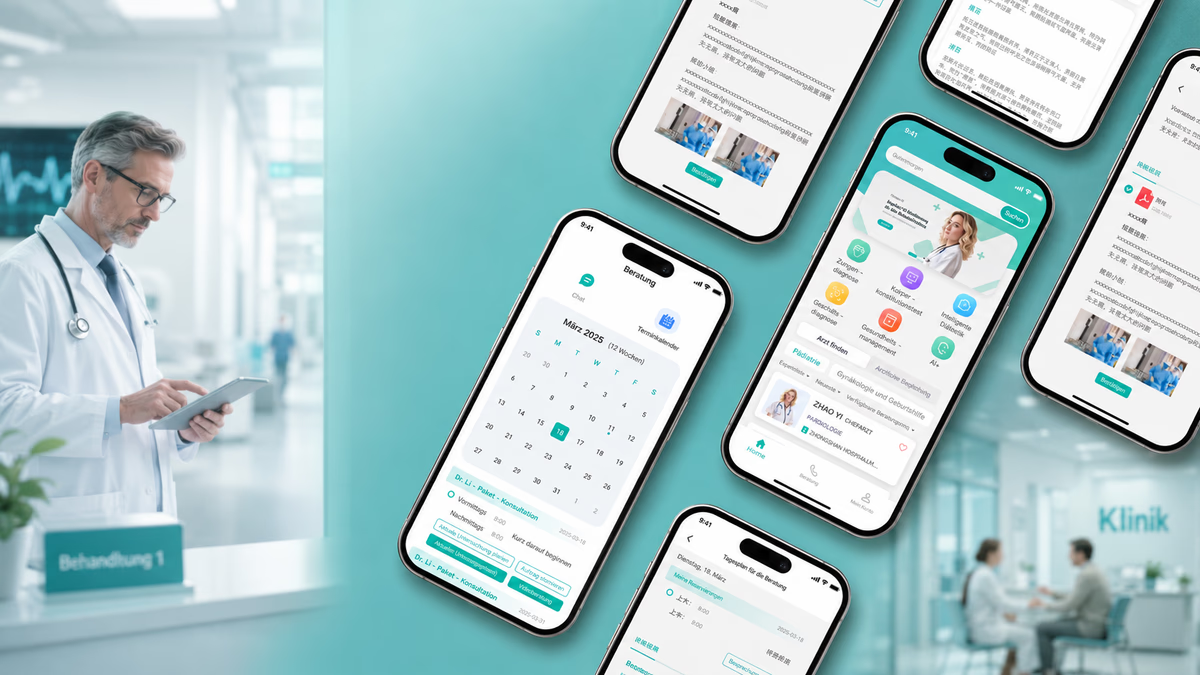
Online consultation's value depends on connecting to real medical services.
Video consultation alone can only address a portion of medical inquiries. When users require further tests, follow-ups, or offline treatment, if online records cannot be carried forward, patients must repeat their symptoms, and doctors lack full context.
So we didn't focus on simply adding an online chat feature. Instead, we re-engineered the entire patient journey from health consultation, appointment scheduling, and assessment to offline care. We wanted the online channel to be part of the entire care continuum, not an isolated entry point.
Permissions, accuracy, and accountability boundaries—none can be ambiguous.
Doctors, patients, operations staff, and offline institutions need to collaborate, but each role has different data access and operational permissions. Overly open information risks sensitive health data breaches; overly restrictive access hinders care continuity.
AI can help organize information and perform initial assessments, but it cannot replace a doctor's professional diagnosis. Multilingual scenarios involving French, Dutch, and other languages require higher accuracy and traceability than standard translation.
Make AI an assistive layer in medical workflows, not the liable party.
We unified online consultation, appointment booking, health information, physician services, and follow-up records into a single workflow, giving patients and doctors continuous context within authorized boundaries and reducing redundant communication.
For permissions and compliance, we control information boundaries through role-based access, user authorization, sensitive data isolation, and audit trails. We also clearly communicate in the product that AI results are for reference only and do not replace medical judgment.
On the commercial side, the platform serves both user-facing consultations and service packages, while also providing digital operations tools for clinics, health centers, and partner institutions—creating a dual model of B2C services and B2B system capabilities.
What we truly solve is the problem of online healthcare having an entry point but no closed-loop follow-up services.
Technology is not the goal — exponential business growth is.