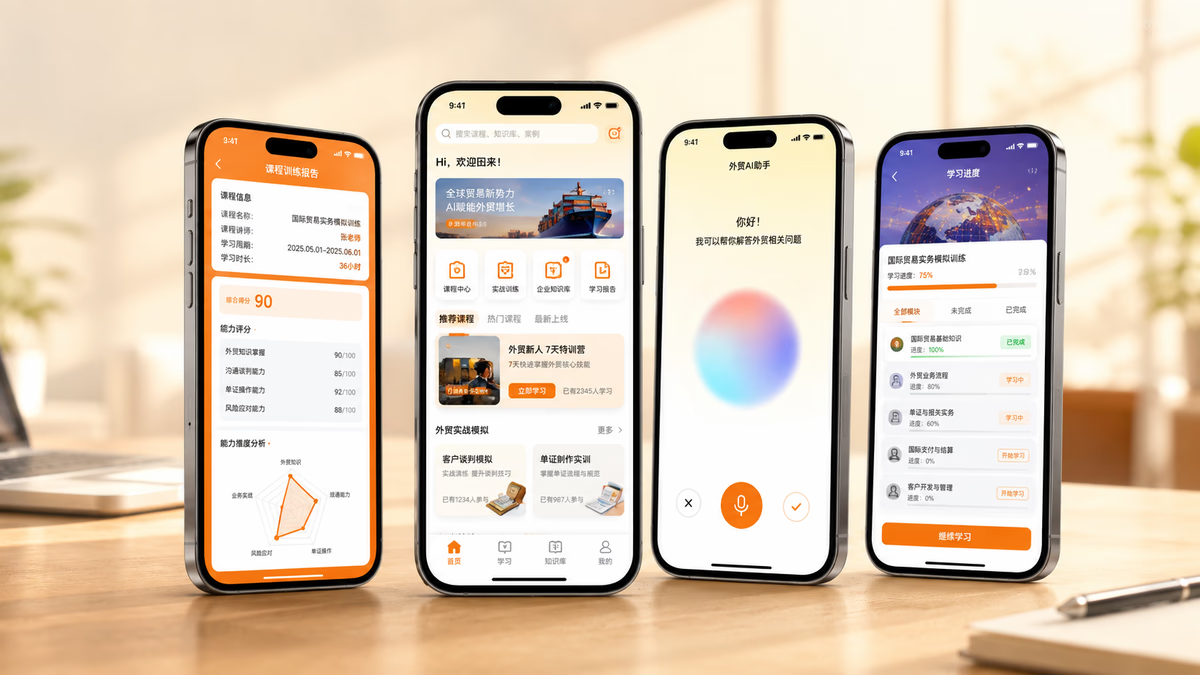
We have developed a cross-border sales AI training system for manufacturing teams expanding globally, integrating live and recorded courses, training assessments, multi-region customer simulations, corporate knowledge bases, and team learning data into a single platform. Training no longer stops at "how many courses were completed" — it goes further to verify whether employees can apply what they have learned to real customer interactions and business execution.
The goal of corporate training is not to finish courses, but to improve on-the-job performance.
Traditional training often measures results by course completion rates, but it is difficult for managers to determine whether employees truly master product materials, customer communication, and sales processes. Especially in cross-border sales scenarios, communication styles vary significantly across countries, industries, and customer types, and generic courses cannot cover all of a company's real-world issues.
Therefore, we did not turn this project into a typical online course system. Instead, we placed learning content, company materials, and employees' daily business into the same capability growth chain.
Courses, corporate knowledge, and employee performance have long been siloed in three separate systems
The content employees see on the learning platform may not align with the product materials, pricing logic, and communication scripts used in daily operations. If AI simulations are detached from the business context, they can only provide superficial language practice.
Enterprise knowledge bases may also contain sensitive product, customer, and sales data, which must be strictly isolated between different companies, and internal roles also need to have different access permissions.
Transform the training platform into an enterprise capability management system
We consolidate course learning, AI conversation practice, training, and evaluation data, then combine them with the enterprise's own product materials and communication rules to generate customer simulations and employee capability assessments that are closer to real business scenarios.
In terms of data security, each enterprise has an independent knowledge space and role-based permissions, so internal materials are not accessed or mixed by other customers, and AI calls are always completed within the enterprise's own knowledge boundaries.
In terms of business model, the system adopts an enterprise subscription and account seat model, with the enterprise knowledge base, AI usage, and customized training scenarios as value-added capabilities to support long-term service.
What we solve is the hardest question in corporate training: money is spent and courses are taken, but whether employees' real business capabilities have actually improved.
Technology is not the goal — exponential business growth is.