
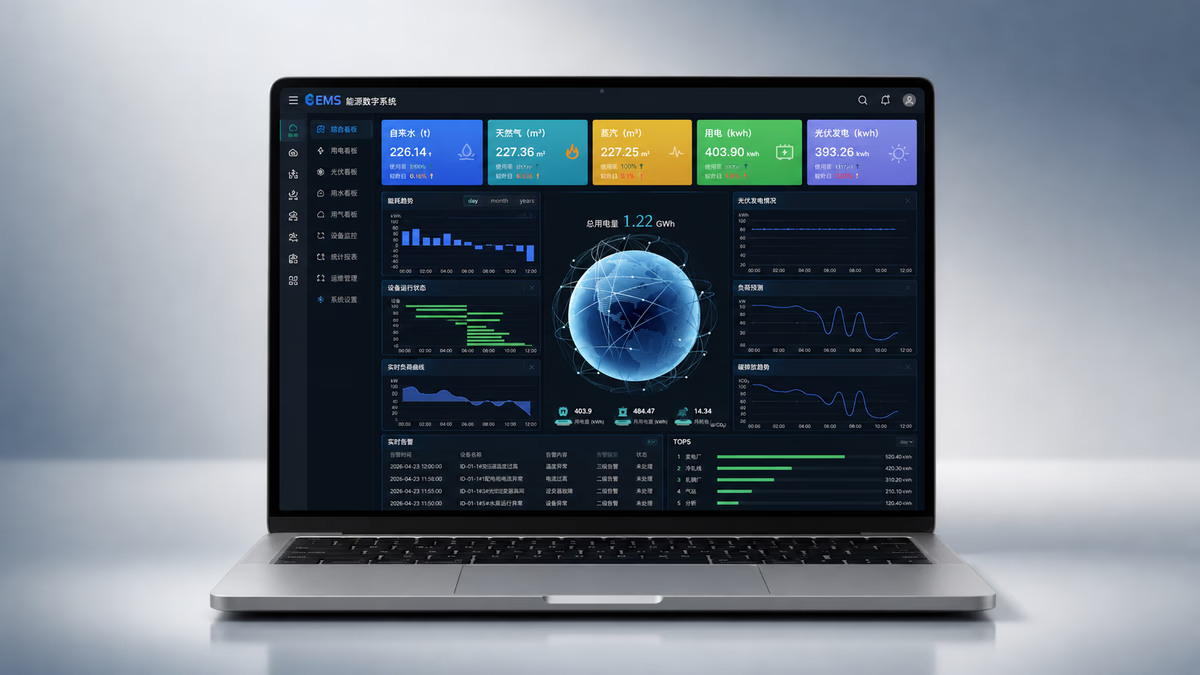
We have built an EMS energy digital system for commercial parks and public facilities that centrally monitors electricity, water, cooling, heating, and carbon emission data. Through AI, it performs load forecasting, equipment health analysis, anomaly alerts, and energy consumption optimization, providing decision support for large parks, complex stations, and enterprise energy management. The system not only answers "how much energy has been used" but also helps managers determine "how to adjust next."
Energy management can't wait until month-end to understand the bill
Traditional energy systems are usually centered on statistics and reports, meaning managers can only spot problems after energy consumption has already happened. For commercial parks, public facilities, and mixed-use complexes, the true value lies in predicting demand ahead of time, catching anomalies early, and adjusting strategies before costs spiral.
That's why we transformed the project from a data display system into an energy decision-making system. Data collection is only the beginning—the real goal is to feed into actual scheduling and operational actions.
Multi-energy data must be clearly tied to business benefits
Electricity, water, cooling, and heating have different metering methods and usage patterns. The system must first complete unified collection, cleaning, and display to form a complete perspective.
If AI predictions only output complex model results, managers still won't know what to do. Each optimization suggestion needs to explain how it will impact costs, equipment, and production plans to be truly actionable.
Feed AI results directly into energy scheduling and operational decisions
We display multiple types of data in real time through the Energy Digital Hall, and combine historical trends to predict future loads, equipment risks, and abnormal changes, moving issues from post-event statistics to pre-event judgment.
In terms of management systems, we establish device, building, and organization-level permissions, and record data sources, alarm processes, and operational results to ensure the security of key energy data and enable optimization results to be reviewed.
In terms of business models, in addition to software licensing and implementation services, we also incorporate energy-saving analysis, continuous operations and maintenance, and performance services into long-term cooperation, linking system value with actual savings results.
What we solve is the most common 'last mile' of energy projects: data has already been collected, but it has never truly been transformed into executable, measurable business decisions.
Technology is not the goal — exponential business growth is.