Expanding your business to overseas markets is the dream of countless Chinese enterprises. However, the first step—technology stack selection—can plunge many teams into decision paralysis. Should you pursue native development for the ultimate experience? A cross-platform solution balancing efficiency and performance? Or a lighter, faster PWA embracing the web? This is not merely a technical choice but a critical business strategy decision. It directly impacts your development costs, time-to-market, user experience, and ultimately your business success. As a technology partner deeply rooted in the overseas market, GeekDance will provide you with in-depth analysis to help you make the wisest choice.
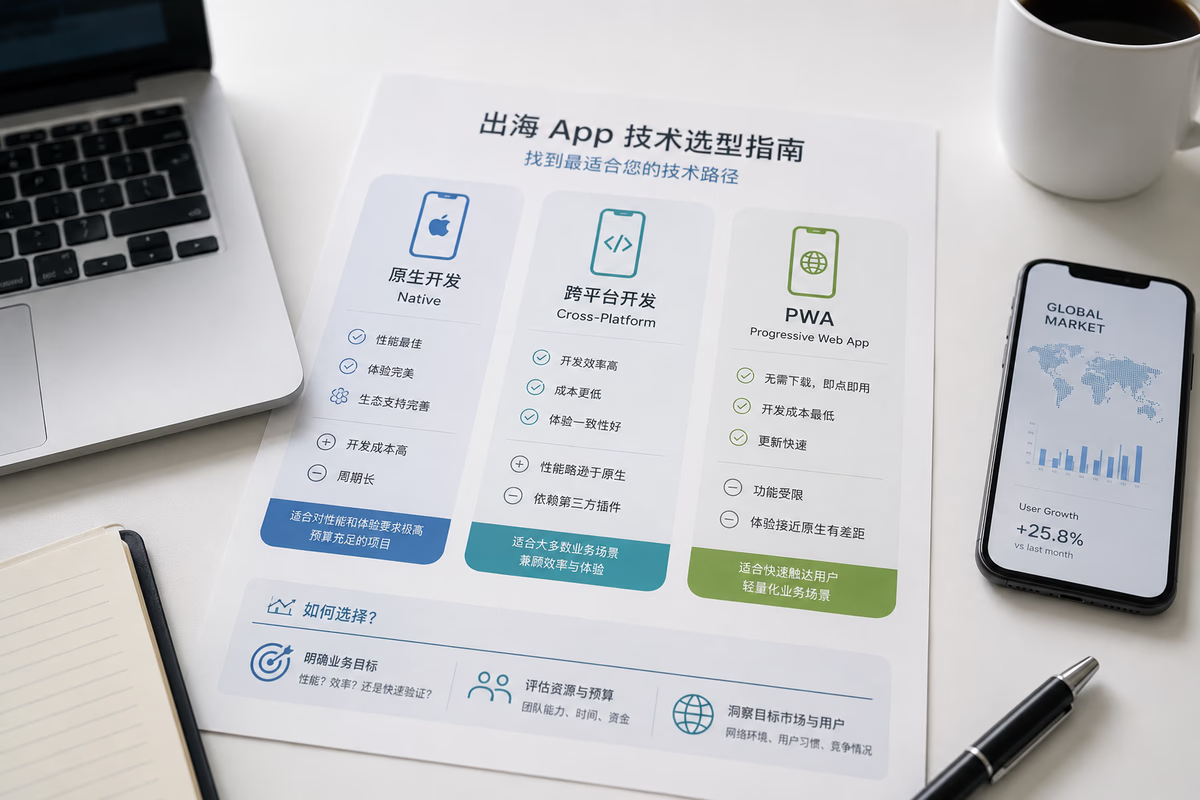
I. In-Depth Analysis of the Three Technical Paths
1. Native Development
Definition: Using the platform's official language and tools for development (Kotlin/Java for Android, Swift/Objective-C for iOS).
Advantages:
Peak Performance: Directly calls device hardware (GPU, sensors, etc.), enabling the smoothest animations, fastest response times, and lowest power consumption.
Perfect Experience: 100% adheres to platform design guidelines, providing the most native and user-friendly interaction experience, seamlessly integrating system services (e.g., payments, notifications).
Ecosystem Support: Gets first access to new OS features (e.g., Privacy Sandbox, new SDKs) and all the latest platform APIs.
Challenges:
High Cost, Long Cycle: Requires maintaining two codebases and two teams, doubling development and testing costs, with the longest time-to-market.
Complex Coordination: Ensuring consistency in functionality and experience across both platforms demands high project management skills.
2. Cross-Platform Development
Definition: Using a single codebase to compile applications that run on both Android and iOS (representative frameworks: React Native, Flutter).
Advantages:
High Development Efficiency: One codebase covers two major platforms, greatly reducing development and maintenance costs, shortening time-to-market—a boon for resource-limited teams.
Consistent Experience: Business logic is fully unified, effectively ensuring high consistency of core functions and UI across both platforms.
Hot Reload/Update Capability: Some frameworks support hot reload or updates, bypassing app store reviews to quickly fix bugs or release new features.
Challenges:
Performance Trade-off: Communication with native via bridge (React Native) or self-drawing engine (Flutter) results in slightly inferior performance in complex animations and heavy interaction scenarios compared to native.
"Lowest Common Denominator" Effect: Relies on third-party plugins to call native functions; support for new system APIs may be delayed, or you may need to develop native modules yourself.
Increased App Size: The engine itself adds to the application's size.
3. Progressive Web App (PWA)
Definition: A web application developed using web technologies (HTML5, CSS3, JavaScript) that can provide an experience similar to a native app.
Advantages:
Extreme Lightweight: No download or installation required; accessible via browser, with extremely low user acquisition cost. A powerful tool for reaching "light users."
Lowest Development Cost: Only one front-end team needed; one codebase covers all platforms (including desktop).
No Store Publishing: Completely bypasses App Store and Google Play review and revenue sharing; updates take effect immediately.
Challenges:
Limited Functionality: Cannot deeply integrate system features (e.g., Bluetooth, NFC, advanced notifications); iOS support for PWA remains conservative.
Experience Gap: Noticeable differences in startup speed, animation smoothness, and offline capabilities compared to native apps.
Discoverability: Cannot fully leverage app store traffic and ecosystem like native apps.
II. GeekDance's Ultimate Selection Guide: No Best, Only Most Suitable
Choosing a solution depends on your business type, target market, user base, and resource status. We have built the following decision model for you:
Choose [Native Development] if:
Your app is performance-intensive: e.g., large 3D games, professional video editing, AR/VR applications.
User experience is the absolute core: You pursue perfection in every interaction animation and require deep seamless integration with the OS (e.g., finance, social apps).
You have ample budget and time: Willing to invest double resources for a top-tier experience.
Choose [Cross-Platform Development] if:
You prioritize development efficiency and cost-effectiveness: Startups or projects needing to quickly validate the market (MVP) with one team covering two platforms.
Your app is content and service-driven: e.g., e-commerce, news, enterprise tools, lifestyle services. The core of such apps lies in business logic rather than extreme animations; Flutter/React Native performance is sufficient.
You need to balance experience and speed: This is currently the optimal solution for most overseas businesses.
Choose [PWA] if:
Your goal is rapid reach and conversion: As a complement to native apps for marketing, user acquisition campaigns, or serving long-tail users who "don't want to download an app."
Your app functions are relatively simple: e.g., restaurant menus, news portals, event display pages.
Target market has limited network conditions: In emerging markets, users have limited storage and expensive data; PWA's "click-and-use" nature is a huge advantage.
III. GeekDance's Professional Advice: Hybrid Strategy and Future Vision
In real projects, an either-or choice is often dangerous. We typically recommend a more strategically minded hybrid development strategy for our clients:
"PWA + Native App" Combination: Use PWA as a lightweight frontend to attract global users at low cost, then use incentives to guide core users to a more feature-rich native app for deep engagement. This perfectly solves the dual challenges of "acquisition" and "retention."
"Cross-Platform Main, Native Modules Auxiliary": Develop the main application based on Flutter or React Native, and for the few performance-sensitive functions or those requiring special native APIs (e.g., advanced beauty filters, payment SDKs), develop native modules separately for embedding. This achieves a perfect balance between efficiency and capability.
Conclusion:
Technology selection is the first and most critical step in going global. There is no standard answer, but there is an optimal solution.
GeekDance not only provides technical consulting but can also be your technology partner. We have deep expertise in native, Flutter, and frontend technologies. Based on your business blueprint and target market, we will tailor the most reasonable technical architecture and implementation path for you, helping you avoid pitfalls and set sail steadily.
Technology is not the goal — exponential business growth is.