Hello everyone, this is GeekDance. When it comes to "business process automation," many people think of Excel formulas for auto-summing or printers outputting paper in sequence—these are basic automation, capable only of preset fixed operations. Currently, AI software is driving automation toward a higher level of "intelligence," breaking through the limitations of traditional automation and upgrading from "mechanical execution" to "autonomous handling of complex tasks." So how does AI enhance the degree of business process automation?
1. First, clarify: The core difference between traditional automation and AI automation
Traditional automation relies on pre-set fixed rules and can only handle standardized tasks. For example, a financial reimbursement system can automatically calculate amount data in a clear format, but when encountering non-standard scenarios such as handwritten invoices or vague reimbursement reasons, it fails and requires manual intervention to proceed.
AI automation, on the other hand, adds data analysis, logical judgment, and autonomous learning capabilities on top of the "rule execution ability" of traditional automation. Taking the RPA+AI system built by GeekDance for a manufacturing company as an example, the system can not only automatically record attendance data (executing fixed rules) but also analyze attendance records through AI to determine whether overtime hours comply with company policies (logical judgment), ultimately reducing the payroll calculation error rate from 5% to 0.3%.
In short, AI automation breaks through the limitation of "only handling standardized tasks" and can effectively address non-standard scenarios in business, increasing the full automation rate of processes.
2. Four core capabilities of AI to enhance automation (with case illustrations)
AI does not rely on a single technology to achieve automation upgrades but combines multiple technical capabilities to cover over 80% of business scenarios. The following four core capabilities are key to how AI enhances automation:
1. Processing "unstructured data": Breaking the data limitations of traditional automation
About 70% of enterprise data is "unstructured data," including handwritten reimbursement forms, scanned contracts, customer voice messages, and reports in image format. Traditional automation cannot recognize such data and relies on manual entry and processing, which is inefficient and error-prone.
GeekDance uses three types of technologies to achieve automated processing of unstructured data:
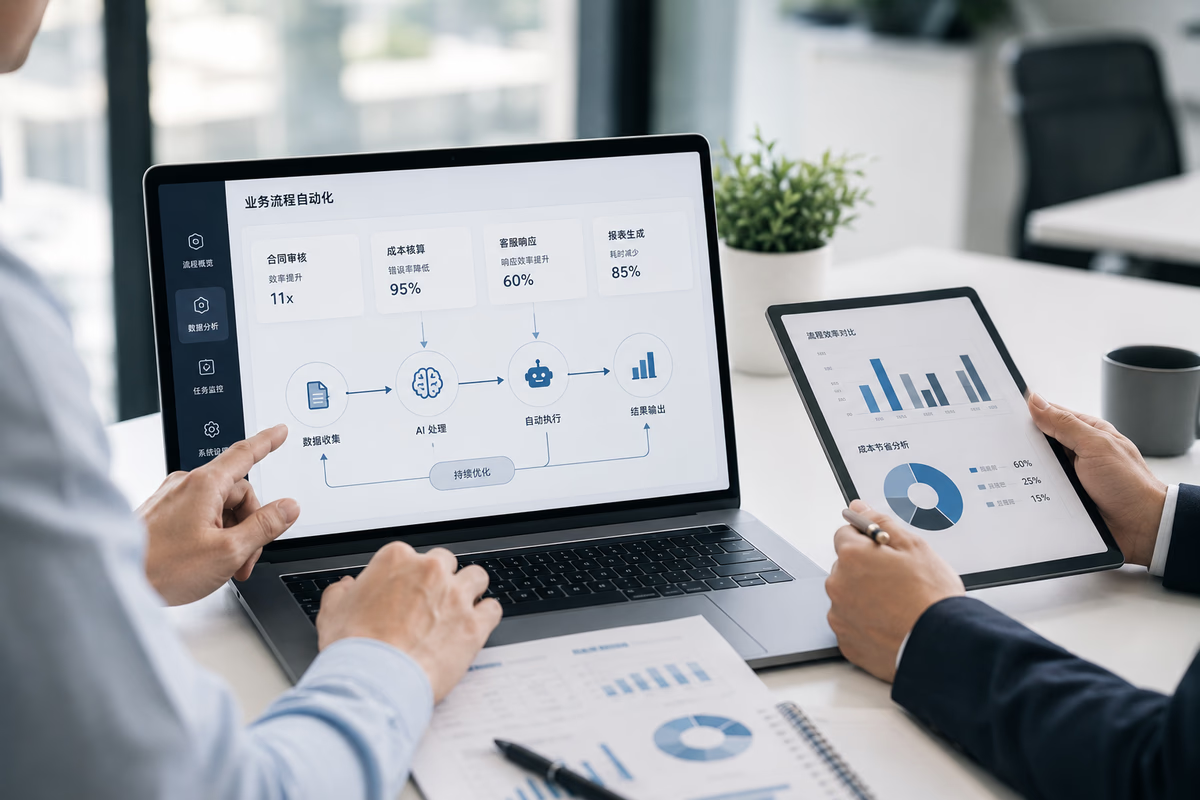
Natural Language Processing (NLP): Can identify key information and logical relationships in text. The contract review AI Agent developed by GeekDance for a chain organization can automatically retrieve documents to be reviewed and verify 12 core items against a standard clause library. Reviewing a contract takes only 10 minutes, compared to 2 hours for manual review, improving efficiency by 11 times and reducing the error rate from 8% to 0.5%.
Computer Vision (CV): Can identify detailed information in images. In GeekDance's global invoice processing solution, AI can automatically recognize consumption location information on receipts, call a currency exchange API to convert to RMB, record it in Excel, and generate financial reports—all without manual data entry.
Speech Recognition and Synthesis: Can convert speech to text and process it. The intelligent customer service system developed by GeekDance for a financial client can identify a customer's request of "order not received," automatically retrieve logistics information, and reply without manual transfer, improving customer service response efficiency by 60%.
By processing unstructured data, AI fills the core短板 of traditional automation, enabling more data-driven processes to be automated.
2. Achieving "complex decision automation": Replacing manual experience-based judgment
Some business process bottlenecks are not due to a lack of rules but because the rules are too complex—requiring comprehensive multi-dimensional data judgment. For example, project estimation needs to integrate geographic data, equipment parameters, policy documents, etc.; inventory management needs to adjust based on sales volume, weather, promotional activities, etc. Traditional automation cannot handle such decision-making steps that require "experience-based judgment."
GeekDance uses multi-agent collaboration and model training to enable AI to automatically complete complex decisions:
After a new energy group introduced GeekDance's multi-agent solution, the efficiency of photovoltaic project report generation significantly improved. The "estimation agent" calls a multi-dimensional database to calculate power generation, with an error margin within 3%; the "policy agent" crawls documents from 31 provincial development and reform commissions in real-time to mark applicable clauses; the "coordinator agent" aggregates data and checks for missing information. Ultimately, report generation time was reduced from 5 hours to 1.8 hours, and the rework rate dropped from 60% to 0.
GeekDance built a supply chain collaborative ERP for a consumer electronics brand, using AI demand forecasting algorithms to integrate multi-dimensional data, reducing stockout rates by 42% and improving inventory turnover efficiency by 35%.
In a multinational AI hardware project, GeekDance created a full-chain "collect-analyze-decide" system, achieving a delay of ≤0.5 seconds from signal collection to decision output, with decision suggestion accuracy reaching 92%, helping the client increase product commercial value by 40%.
Such AI decisions are based on massive historical data and business logic, making them more accurate and efficient than manual decisions.
3. Possessing "process adaptability": Reducing manual maintenance costs
The stability of traditional automation depends on a "fixed environment." If the system interface updates, data format changes, or business rules change, the automation process fails, requiring engineers to reconfigure rules, resulting in high maintenance costs.
GeekDance's AI technology gives automation processes "self-learning and adaptive capabilities," allowing them to adjust operational logic based on business changes:
GeekDance's Computer Use Agent (CUA) achieves autonomous adaptation through a "perception-reasoning-execution" loop. It captures screen images to obtain environmental status, uses chain-of-thought reasoning to dynamically respond to system changes, and when encountering new challenges, it can learn from historical data to adjust operational logic without manual reconfiguration.
In a manufacturing company's equipment maintenance system, GeekDance's multi-agent solution demonstrated strong adaptability: after the "diagnosis agent" locates a fault, the "inventory agent" synchronizes spare parts data, and the "scheduling agent" automatically diverts orders. Fault response speed increased by 3 times, and downtime losses dropped from 10 million/year to 4.8 million.
GeekDance's AI monitoring system uses deep learning models to analyze logs and performance metrics, predicting database connection pool exhaustion risks 48 hours in advance and automatically scaling resources, reducing system downtime by 65%.
This "adaptability" allows automation processes to keep up with business changes, reducing the maintenance cost of repeated adjustments.
4. Achieving "human-machine collaboration optimization": Focusing on high-value work
AI does not replace humans but takes over repetitive, low-value tasks, freeing people from tedious labor to focus on more core work, forming an efficient "human-machine collaboration" model.
GeekDance's solutions have achieved human-machine collaboration optimization in multiple roles:
Contract review role: The AI Agent automatically checks clauses, marks anomalies, and pushes for approval, only submitting complex anomaly cases for manual processing. After a chain law firm introduced it, the team could focus on case strategy research, increasing core work time by 40%.
After-sales support role: The AI Agent handles 70% of routine inquiries (such as logistics tracking, rule explanations), while humans focus on complex complaints. The system developed by GeekDance for a financial client improved customer service response efficiency by 60% and customer satisfaction by 25%.
Development role: GeekDance's AI-assisted development tool supports describing requirements in natural language, automatically generating front-end and back-end code and API documentation. An e-commerce team used it to develop a promotion system, going from requirement confirmation to launch in just 4 hours, allowing developers to focus on core logic design.
Practice shows that 90% of GeekDance's AI automation applications help employees break free from repetitive tasks and focus more on creative work.
3. Three key steps for enterprises to implement AI automation
Many companies want to try AI automation but worry about "technical complexity" or "high costs." In reality, implementation does not require a "one-step" approach; following these three steps can efficiently advance:
Start with "high-cost-performance scenarios": Prioritize scenarios with "many repetitive tasks and high labor costs," such as contract review, data aggregation, attendance statistics, etc. A fast-moving consumer goods brand started with the scenario of aggregating sales data from all channels. After introducing GeekDance's AI Agent, aggregation time was reduced from 6 hours to 15 minutes, and after verifying the effect, they gradually expanded the application scope.
No need to rely on "large models": 70% of business scenarios can be met with lightweight models. For example, the AI health analysis module developed by GeekDance for smartwatches ensures accuracy while reducing computing power costs, adapting to hardware-side operation requirements, with computing power consumption only 1/5 of large model solutions.
Promote "business and technology collaboration": Let business employees and technical teams participate in design together. GeekDance's dedicated team conducts on-site research, follows employees' "workflows" to identify pain points, and then customizes solutions. This model makes AI automation implementation three times faster than IT team-led approaches.
In essence, the core of AI enhancing business process automation is "using technology to unblock bottlenecks, breaks, and pain points in processes"—from efficient estimation of photovoltaic projects, to precise supply chain forecasting, to intelligent contract review verification. AI is making complex processes that once relied on manual work become "more automated, more accurate, and more worry-free."
Technology is not the goal — exponential business growth is.