During digital transformation, data silos between systems like ERP, CRM, and OA often lead to inefficient processes, duplicate data entry, and delayed decision-making. Based on a multi-agent technology framework and experience from over 300 enterprise projects, GeekDance has developed a mature ERP+CRM integration solution that supports API direct connection, middleware collaboration, and legacy system adaptation, helping enterprises achieve data interoperability, process automation, and business collaboration. This article uses real cases from a new energy group and cross-border e-commerce to detail the core logic, implementation steps, and customized development plans for system integration, providing a clear path for enterprise digital upgrade.
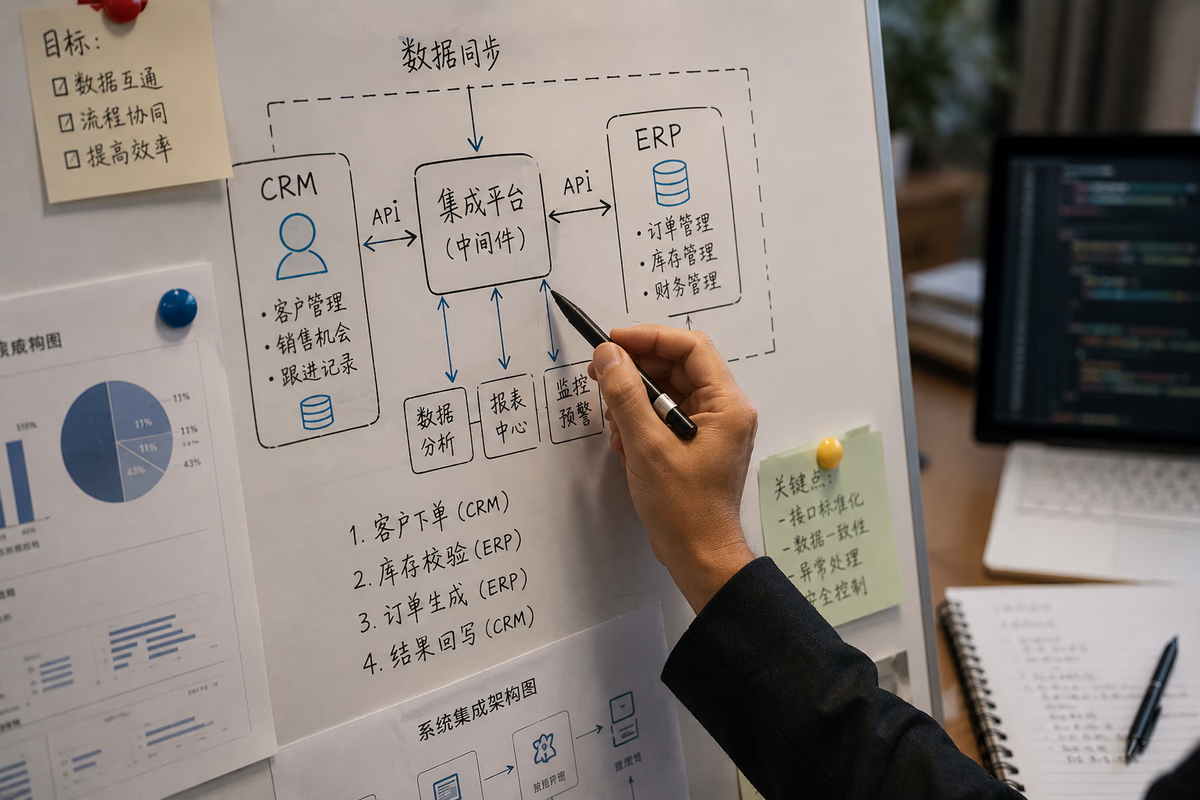
Whether it's cloud SaaS, on-premises, or hybrid architecture ERP/CRM, GeekDance can achieve data interoperability and process collaboration through mature technical solutions. This capability has been validated in digital transformation projects across more than 300 clients in various industries, with stable results.
1. Three Integration Approaches: Choose Based on Enterprise Reality
GeekDance, built on a multi-agent technology framework, offers three core integration approaches that enterprises can select based on their IT infrastructure and business needs:
1. Standard API Direct Connection (Recommended)
Using standardized interfaces like RESTful APIs and Webhooks, ERP and CRM data can be synchronized in real time. For example:
When a new customer order is created in CRM, the system automatically calls the ERP's "inventory query API" to check stock availability (response in milliseconds). If stock is sufficient, a sales order is generated directly in ERP;
GeekDance's "coordinator" communication agent automatically handles field mapping (e.g., CRM's "customer level A" corresponds to ERP's "VIP customer"), eliminating manual adjustments.
2. Middleware Integration Platform (Suitable for Complex Multi-System Scenarios)
If an enterprise needs multiple systems like ERP, CRM, and OA to work together, a low-code middleware can be added as a data hub. Without extensive coding, data flows can be configured visually—for example, "new customer in CRM → automatically sync to ERP to create customer profile → trigger financial system to open account." This lowers technical barriers and supports cross-system orchestration.
3. Database and File Collaboration (Adapting to Legacy Systems Without Open APIs)
For older systems without open APIs, integration can be achieved indirectly through database views, intermediate tables, or file import/export. For instance, inventory data from ERP is batch-synced to GeekDance system daily at midnight, analyzed by the "inventory agent," and then pushed to CRM, enabling the sales team to make accurate quotes based on that data.
2. What Value Does Integration Bring? Real Cases Make It Clear
(1) Core Business Benefits
In data unification, it solves the data silo problem where "customer info is in CRM but order data is in ERP." This is achieved through multi-agent automatic data consistency checks, eliminating manual cross-system data retrieval.
For process automation, orders that originally took 2 hours can be completed in 30 minutes, thanks to real-time API calls and optimized workflows that reduce manual handoffs.
In decision optimization, sales forecast accuracy can improve by about 40% because the system integrates cross-system data from ERP, CRM, etc., for more informed analysis.
For cost control, manual data entry error rates can drop from 15% to below 3% due to automatic field mapping and real-time anomaly monitoring, reducing rework costs from incorrect entries.
(2) Two Typical Industry Cases for Reference
New Energy Group (ERP Integration): After integrating GeekDance system with Yonyou ERP, the "calculation agent" automatically retrieves equipment procurement cost data from ERP and combines it with solar radiation databases to calculate photovoltaic project returns. Report generation efficiency improved by 64%, and rework rate dropped to 0;
Cross-Border E-commerce (CRM+ERP Integration): By integrating Shopify CRM with Kingdee ERP, the "customs clearance agent" synchronizes order data and ERP inventory in real time, reducing customs delay rates from 25% to 3%, saving over 8 million RMB in losses annually.
3. How to Implement? Four Steps with Controlled Risk
GeekDance uses a "first understand business, then configure technology" approach to ensure smooth integration projects:
Preliminary Assessment: Form a cross-department team to clarify data dictionaries (e.g., unify product coding rules) and evaluate ERP/CRM database types and API openness;
Phased Implementation: Start with basic synchronization of "customer info + orders," then proceed to full-chain integration of "inventory - after-sales - finance." Each phase is validated with KPIs (e.g., order sync success rate must be above 99.5%);
Security Protection: Data transmission uses SSL encryption, fine-grained access control (e.g., sales can only view inventory, not modify financial data), and operation logs are retained for auditing;
Continuous Optimization: Set up a monitoring platform to alert on interface issues (e.g., sync interruption due to network fluctuations). As business needs evolve (e.g., new pre-order types), interface functions can be extended.
4. Common Questions Answered
Q: Can cloud and on-premises systems be integrated?
A: Yes, hybrid architecture integration is supported. Using an IPAAS platform, SaaS CRM and on-premises ERP can automatically sync data. This has been adapted for mainstream systems like SAP and Oracle;
Q: Will system upgrades after integration be affected?
A: Version-compatible interfaces are reserved, and compatibility tests are performed before upgrades to avoid short-term instability.
5. Custom Development: Building a CRM+ERP System Tailored to Deep Enterprise Needs from Scratch
For enterprises with unique business logic, industry-specific processes, or long-term digital strategy plans, standard integration solutions may not fully cover requirements. To address these personalized needs, GeekDance offers "from scratch" custom development services, creating a unique CRM+ERP system tailored to the enterprise.
Our custom development revolves around "fitting the enterprise's reality" and is reflected in three dimensions:
1. In-depth Requirements Research: Form a dedicated consulting team to deeply analyze the enterprise's industry characteristics (e.g., production traceability needs in manufacturing, customer tier management in services), core business processes (e.g., multi-platform order integration in cross-border e-commerce, project cost accounting in new energy), and long-term development goals (e.g., business expansion plans for the next 3-5 years), ensuring system development aligns with corporate strategy;
2. Full-Chain Architecture Adaptation: From underlying database design to front-end interface, from data flow logic to cross-department collaboration rules, everything is customized to the enterprise's actual scenario—for example, developing a dedicated chain for chain retail enterprises where "store sales data syncs in real time to ERP inventory + CRM customer profiles update automatically," or building a closed-loop process for manufacturing enterprises where "orders trigger production plans + inventory linked to procurement";
3. Full-Cycle Service Support: Custom systems are not "delivered and done." GeekDance provides full-cycle services from development testing, go-live training, to subsequent iterations. As the enterprise's business expands (e.g., new product lines, new markets), system functions can be quickly upgraded and optimized to ensure the system always keeps pace with the enterprise's development.
Whether it's integrating existing systems or developing a new custom CRM+ERP system, GeekDance focuses on "solving real enterprise problems and supporting digital transformation," offering flexible and stable digital solutions for enterprises of different industries and sizes.
Technology is not the goal — exponential business growth is.